We Poke Along
In May of 1935, Franklin Roosevelt signed Executive Order 7034, establishing the Works Projects Administration. The WPA replaced the Federal Emergency Relief Agency. You see, they didn’t have any cut-and-dried answers. They were in unfamiliar territory and kept trying things, until they got it right. The WPA only existed for eight years, but over the course of its life, it employed a total of 8,500,000 people.
Republicans called it a bastion for waste and pork barrel projects, lampooning the acronym of WPA as “We Poke Along.” Their answer was to let the marketplace work. Those eight and a half million people didn’t need jobs. All they really needed was self-reliance and faith that tomorrow would be a better day.
At its height, the WPA employed 3,400,000 workers who worked a maximum of 30 hours per week. The goal was to put enough money in the workers’ pockets to keep a roof over their heads and feed themselves. Thirty hours made room for more workers and also time for those employed workers to look for private employment. No more than one person per family was allowed to participate in the WPA. In those eight years, the WPA built over 651,000 miles of streets, roads and highways. They built or repaired 124,031 bridges. They built, modernized or repaired 125,031 public buildings. They built 851 airport landing fields and 8,192 public parks and playgrounds. The Federal Writer’s Project created pamphlets and guidebooks and organized state archives. The Federal Arts Project, employed artists to create murals, sculptures and canvases to decorate schools and public buildings.
In the cities, the WPA organized summer day camps to keep children occupied and to give them a hopeful diversion, complete with a hot meal served at lunch. Symphony orchestras and traveling stock companies toured the country to bring music and theater to the masses that had little in the way of diversions. We poke along indeed.
Night school classes taught welding, radio repair, auto mechanics, aviation mechanics, construction techniques and management techniques. Music & art lessons were available. Training in tailoring and as nursing aides were available, unless you were attending one of the dances sponsored by the WPA. The WPA was about more than just reviving the economy. It was about reviving a people’s spirit as well.
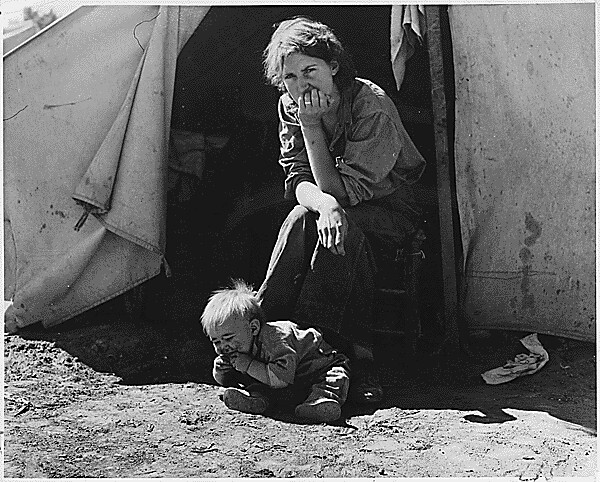
From the homeless to those living in Hoovervilles and hobo jungles, it must have seemed as if Jesus himself had cracked open the sky to rescue them. If you’re unfamiliar with the term Hooverville, it is a hole dug into the ground where the dirt is piled around the edges, and then scrap wood is put over the top and covered with more dirt. It was a hole in the ground used to keep you from freezing to death, when your faith and self-reliance had worn thin.
For unmarried men between the ages of 18 to 26, there was the CCC, Civilian Conservation Corps. The men were paid a dollar a day and a mandatory $25.00 dollar allotment was sent home each month. Enlistment tours were six months and re-enlistment was allowed. One of the first problems was that most of the unemployed were in the East and the bulk of the work was in the West. Roosevelt’s tree army, as they were called, planted 3 billion trees and accounted for half of all reforestations in the United States, public and private, in the nation’s history.
The rules were relaxed to allow veterans to serve in the corps. Many large cities reported drops in crime of over 50% and credited it to the creation of the CCC. But more than just planting trees, it got unemployed teenagers and young men out of the house, allowing strained food budgets to go a little farther. Camps were set up in all of the states, and eventually, reached a total enlistment of 500,000 men. Like the WPA, vocational education was a part of the program. The CCC taught 40,000 men to read and write. 90% participated in some aspect of vocational education.
Classes included blacksmithing, bulldozer operation, carpentry, woodworking, and cooking, vocational guidance, use of powder, road construction, tractor operation and photography. Academic classes included English composition, spelling, business arithmetic, trigonometry, Latin, Spanish, and citizenship. Universities offered correspondence courses to the enlistees in auto mechanics, forestry, journalism, and bookkeeping.
The camps competed in athletics and built recreation centers, vying for bragging rights on most-days-worked. Camp Fremont in Wyoming worked every day throughout the winter of 1935. They ran telephone and power lines and built the ranger stations and the docks on Fremont Lake. So good was the record of the CCC that prospective employers looked at them as workers who knew what was expected of them, and who weren’t afraid of a day’s work or a challenge.
The corps built 97,000 miles of fire roads and 3,470 fire towers. They built parks and campgrounds, complete with picnic shelters, swimming pools, fireplaces and public restrooms. In conjunction with the soil conservation service, they reclaimed 84,000,000 acres of arable farmland. The corps fought forest fires and floods, blizzards in Utah and hurricanes in the Gulf, all while planting 3 billion trees, helping to end the dust bowl.
The men returned home a little older and much wiser, with stories to tell and with new confidence and new skills. More than just planting trees, it grounded the men with a new vision of the world, a world where they felt self-assured and confident in their abilities. A kid from Chicago might climb the Rocky Mountains, or a kid from New York was building roads in Virginia or parks in Alabama.
The CCC changed the way the United States treated its forests and farmlands. The dust bowl had taught us how fragile these ecosystems are. They ushered in an era of stewardship, because those 3 billion trees planted weren’t new forests, they were planted to replace the 3 billion cut down by the free market and never replaced. Soil conservation was a new idea that has never been forgotten and is now the watchword in modern farming worldwide.
It is utterly amazing all that was accomplished in a decade, a decade where putting the well-being of the people first was job one. They changed America and gave a new birth to this nation. From utter hopelessness and devastation to a modern America, open to trying new ideas and new ways. Given hope and skills and an opportunity, they went on to become what we casually call the middle class. Even more, we call them the “Greatest Generation”. But lest we forget how they earned that sobriquet, they had help.
The match they lit was small, but the fire was big. It was opportunity that saved that America generation. An administration that lifted the people up and shook the dust from their clothes, and gave them tools saying, “Now show us what you can do.” Today in America we face a similar crisis, and the answer just seems so simple.
 This Carbon Based Life
Leave a comment