By David Glenn Cox
You really have to do some serious soul-searching when they give the toddler in chief someone else’s Nobel Peace Prize. And the idiot holds it up proudly, smiling like a jackass eating briars. Why not give him Mickey Mantle’s Triple Crown award and he’ll think he’s Yankee baseball great. Maybe a Heisman Trophy or the Kentucky Derby Cup? It’s not his. He didn’t win a Nobel Peace Prize. He’s just a toddler being placated with the old give the baby his bottle. She was once (last week) a nobody, but now, she’s a fine lady!
But this story is Trump-related and corporate-America related. Back at the turn of the twentieth century two high school dropout bicycle mechanics from Dayton, Ohio, after a long and arduous research with gliders, developed the airplane. The Wright brothers made over two thousand glider flights, learning to fly before ever installing an engine. Back in Washington, Professor Langley, the head of the Smithsonian Institution was also trying to build a flying machine. Professor Langley was considered one of the top scientific minds in the country. And he built a steam-powered flying machine which, however wonderful, couldn’t fly.
Well, that settles it then. Powered flight was impossible. It shows us that no matter how many college degrees you have hanging on your wall, it’s no protection against being wrong. Henry Ford, in a search for control of the rubber market, spent two billion dollars on a rubber plantation trying to teach rubber plants to grow on command. Synthetic rubber was developed in a laboratory for less than a million dollars. Innovation sometimes works better than domination.
Several years ago, I was commissioned to write a series of articles on early automobiles. Early automobiles were a joke. The products of a thousand tinkerers in barns across America. But very quickly the good ideas replaced the bad, and the modern automobile was born. The early automobiles were dangerous, fickle, and hard to start. So much so that the Baker Electric Company developed an electric car just for ladies. It had a fifty-mile range and a top speed of around thirty miles per hour. It only had one real drawback. Most people in America didn’t have electricity.
So internal combustion won out over steam and electric. Steam was king! Railroads ran on steam, and ships at sea used steam. But the steam engine also had problems. If you wanted your ship to sail at twelve knots, it took one ton of coal per hour. If you wanted it to sail at twenty knots, it took two tons of coal per hour. It also required a crew of stokers working around the clock to keep it moving. Steam had hit an innovation wall. There were no further developments which could make steam work better or cheaper.
Along comes Rudolph Diesel with his crazy idea for a compression-combustion engine. The early Diesels were large and heavy and cumbersome and inefficient, but they did away with stokers shoveling coal around the clock. The diesel fuel could be placed in a tank out of the way, leaving more room for cargo. Getting rid of half a dozen workers and carrying more cargo was an irresistible combination. Even if the engine wasn’t very efficient, it made the ships more so.
Currently, nearly every automotive company on Earth is suffering with bad engines. Ford, GM, Toyota, and Honda all have their stinkers. And Professor Langley is still on the job. In an effort for more fuel economy and lighter weight. They have developed engines which work well under laboratory conditions, not real-world conditions. You run into dueling calculations. To make the engine lighter, they use smaller thinner engine blocks and smaller displacement. In order to make the engine smaller and more powerful, they added turbochargers, which adds a great deal more heat.
The aircraft mechanics returning home after WW2 began adding turbos to stock cars and dragsters. With the heavier blocks and lower compression engines, they worked fine. But these newer lightweight engine blocks don’t have the capability to handle all that heat. Turbos, and tighter tolerances mean the oil must be thinner to fit in those tighter places. Guess what thinner oil doesn’t do very well? Dissipate heat. Now add in the bean counters; always looking for the cheapest way possible to save a dime. And you have dueling calculations leading to the internal combustion engine disaster.
Like steam, we’ve hit a technological wall with internal combustion engines. Turbos, fuel injection, computer control, four valves per cylinder, Variable timing, shutting down engine cylinders. It all adds money and complications. Until, like Henry Ford, we’re spending billions of dollars seeking the unachievable, when technology is the answer.
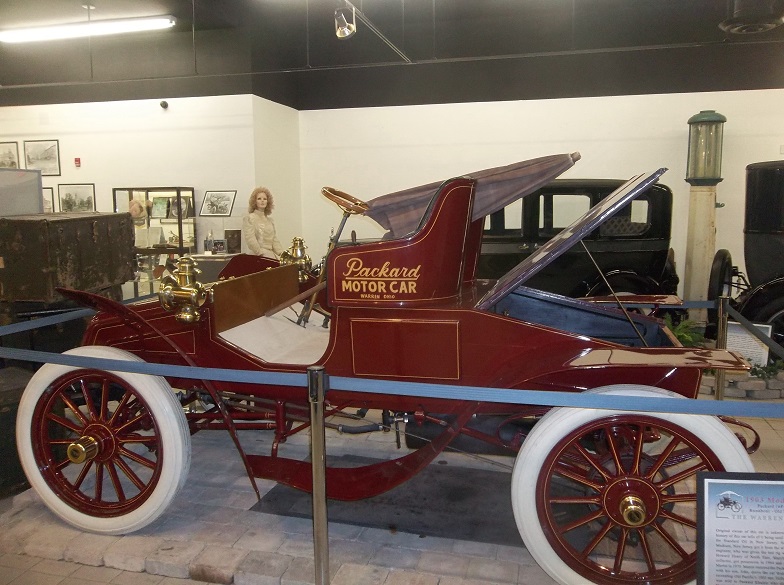
The Teslas of today will be in a museum someday, like Baker electrics. The American market jumped on board with electrics and jumped back off just as fast. The public is now afraid of them. They are too expensive with limited range, a short battery life and long charge times. Let’s do like Henry Ford! In an effort to compete with Tesla, the automakers rushed products to market that didn’t work very well, like a 1901 Packard with wagon wheels and plumbing fixture exhaust systems. Ford has cancelled its electric program, taking a 19 billion dollar hit.
But what if? What if someone developed a battery that would last longer than the car? What if that battery could charge in twenty or thirty minutes? What if that battery could go further on a charge and what if it were cheaper? A lot cheaper. What if it didn’t care if the temperature outside was over a hundred degrees or thirty below? What if it wouldn’t catch fire and used no toxic or rare earth minerals? Enter the sodium battery, now entering the market in China. In this country, President Doofus prefers oil in China and Europe, governments have backed research which has brought about innovation.
In China, electric cars have reached parity with combustion engines. Combustion cars will only get more expensive as electrics become cheaper. The sodium battery is the breakthrough we’ve all been waiting for. America used to lead the world in innovation; today, we are a laggard. We fight for oil! The sodium battery could have been developed in the United States. If the engineers, intellectuals, and bean counters hadn’t been busy trying to build steam-powered airplanes.
The Ford electric F150 was the dumbest idea since Ford’s rubber plantation. The answer wasn’t shoving batteries into a pickup truck, the answer was developing better batteries. Like the automotive revolution of 100 + years ago. The bad ideas are replaced by the good ones. If the discovery of fire had been left up to engineers, we would have frozen to death. GM was a leader in early electric cars and platforms, but not in batteries.
The internal combustion engine, like steam, has hit a technology wall. To build a better engine takes twice as much coal. Yes sir, they can build some great internal combustion engines, just ask Ferrari. Why for three or four hundred thousand dollars per copy, the problems can easily be overcome.
In California and Australia, battery banks are replacing natural gas power plants. The power plants used when electrical demand surges in the evening. The batteries charge all day in the sun and discharge when needed at night. It’s already happening. But this is America, isn’t it? When Edison first electrified a single neighborhood in New York. The gas company promptly sued him. Electricity was dangerous! That crazy Tom Edison is going to get people killed!
“I don’t care that they stole my idea . . I care that they don’t have any of their own”
― Nikola Tesla
 This Carbon Based Life
Leave a comment